
Attractions to Visit
-
Old Quarter
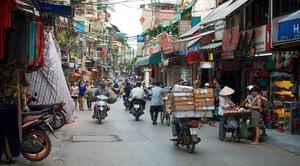 The
Old Quarter is the name commonly given to the historical civic urban core of
Hanoi, Vietnam, located outside the Imperial Citadel of Thăng Long. This quarter
used to be the residential, manufacturing and commercial center, where each
street was specialized in one specific type of manufacturing or commerce.
The
Old Quarter is the name commonly given to the historical civic urban core of
Hanoi, Vietnam, located outside the Imperial Citadel of Thăng Long. This quarter
used to be the residential, manufacturing and commercial center, where each
street was specialized in one specific type of manufacturing or commerce.
Another common name referring to approximately the same area is the 36 streets, after the 36 streets or guilds that used to make up the urban area of the city. -
Hanoi Train Street
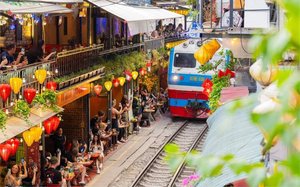 Train
Street or Railway Street is a narrow train bypass in Hanoi which several times
daily sees a train pass close to buildings on either side of the tracks (the
width of the train takes up nearly the entirety of the "train street"). It is
situated specifically, along Điện Biên Phủ and Phùng Hưng streets,opposite
Dropin Cafe and the main Hanoi Railway Station. The track was built by the
French in 1902 and is still an active rail line as of 2026.
Train
Street or Railway Street is a narrow train bypass in Hanoi which several times
daily sees a train pass close to buildings on either side of the tracks (the
width of the train takes up nearly the entirety of the "train street"). It is
situated specifically, along Điện Biên Phủ and Phùng Hưng streets,opposite
Dropin Cafe and the main Hanoi Railway Station. The track was built by the
French in 1902 and is still an active rail line as of 2026.
The train passes several times daily, on the single track line running north out of Hanoi railway station (thus not the rail line between Hanoi and Ho Chi Minh City in the south). Residents living alongside the tracks clear their belongings from the narrow space when trains approach. Often during other times, they use the space for daily activities, like drinking tea and playing board games.[4][5] A writer on the Hanoi Old Quarter travel website wrote: "Hanoi Train Street encapsulates an extraordinary portrait of local life a real-time illustration where trains routinely coalesce with the rhythm of resident sources of pride and heritage." -
Hoan Kiem Lake
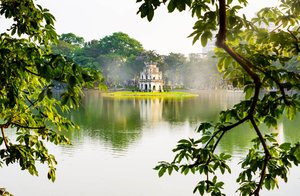 Hoàn Kiếm Lake, also known as Sword Lake (Hồ Gươm) or Tả Vọng Lake (Hồ Tả Vọng),
is a fresh water lake, measuring some 12 ha in the historical center of Hanoi,
the capital city of Vietnam.
Hoàn Kiếm Lake, also known as Sword Lake (Hồ Gươm) or Tả Vọng Lake (Hồ Tả Vọng),
is a fresh water lake, measuring some 12 ha in the historical center of Hanoi,
the capital city of Vietnam.
In the past, the lake was variously named "Lục Thủy Lake" (Vietnamese: Hồ Lục Thủy, meaning "Green Water Lake" - aptly named for the water's color) or "Thủy Quân Lake" (Vietnamese: Hồ Thủy Quân, meaning "Mariner's Lake"). The lake is one of the major scenic spots in the city and serves as a focal point for its public life.
-
Temple of Literature
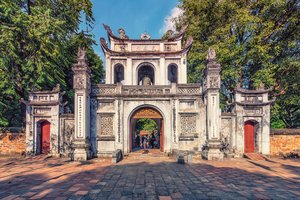 Văn Miếu, literally translated as Temple of Literature, is a temple dedicated to
Confucius in Hanoi, northern Vietnam. The temple was founded and first built in
1070 at the time of Emperor Lý Thánh Tông, and it hosted the Imperial Academy,
Vietnam's first national university, from 1076 to 1779. In 1803, The academy was
moved to the new capital of Nguyen dynasty in Hue.
Văn Miếu, literally translated as Temple of Literature, is a temple dedicated to
Confucius in Hanoi, northern Vietnam. The temple was founded and first built in
1070 at the time of Emperor Lý Thánh Tông, and it hosted the Imperial Academy,
Vietnam's first national university, from 1076 to 1779. In 1803, The academy was
moved to the new capital of Nguyen dynasty in Hue.
The Văn Miếu is one of several temples in Vietnam which are dedicated to Confucius, sages, and scholars. The temple is located to the south of the Imperial Citadel of Thăng Long. The various pavilions, halls, statues, and stelae of doctors are places where offering ceremonies, study sessions, and the strict exams of the Đại Việt took place. The temple is featured on the back of the 100,000 Vietnamese đồng banknote. Just before the Tết Vietnamese New Year celebration, calligraphists will assemble outside the temple and write wishes in Chữ Hán. The art works are given away as gifts or are used as home decorations for special occasions.
-
Hanoi Opera House
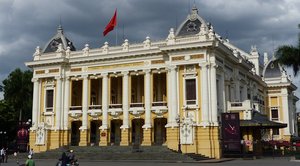 The Hanoi Opera House, or the Grand Opera House is an opera house in central
Hanoi, Vietnam. Built by the French colonial administration between 1901 and
1911, it is one of three opera houses built during the colonial period in French
Indochina, alongside Haiphong Opera House and Municipal Theatre in Ho Chi Minh
City.
The Hanoi Opera House, or the Grand Opera House is an opera house in central
Hanoi, Vietnam. Built by the French colonial administration between 1901 and
1911, it is one of three opera houses built during the colonial period in French
Indochina, alongside Haiphong Opera House and Municipal Theatre in Ho Chi Minh
City.